





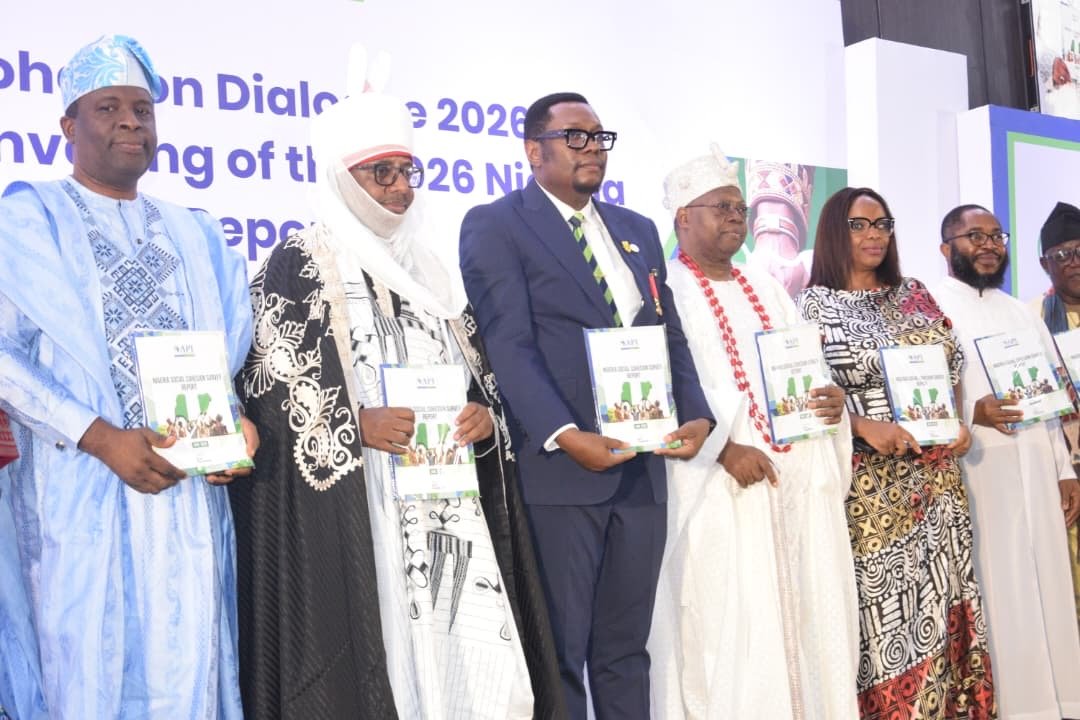
The Africa Polling Institute (API) has released its 2026 Nigeria Social Cohesion Survey, revealing a modest improvement in the country’s social cohesion despite persistent economic and governance challenges.
The report, unveiled on Thursday during the National Social Cohesion Dialogue in Abuja, puts Nigeria’s Social Cohesion Index (NSCI) at 48.8 percent, representing a two-percentage-point increase over the previous year’s figure and the highest score recorded since the survey began. Although the index remains slightly below the 50 percent benchmark considered the average threshold for social cohesion, API says the improvement reflects the resilience of Nigerians and their continued willingness to coexist despite prevailing hardships.
One of the report’s most striking findings is the continued confidence Nigerians place in religious and traditional institutions compared to public office holders. According to the survey, 51 percent of respondents expressed significant trust in religious leaders, while 45 percent trusted traditional rulers. By contrast, only 28 percent said they trust the administration of President Bola Ahmed Tinubu, while 23 percent expressed trust in the National Assembly, making it the least trusted public institution in the country. The Nigeria Police Force, previously ranked lowest in public trust, recorded a slight improvement with 24 percent.
The survey was conducted by the Africa Polling Institute with support from the Ford Foundation between January and February 2025. A total of 5,315 Nigerians aged 15 years and above were interviewed through face-to-face household visits using a stratified random sampling technique. Interviews were conducted in English, Pidgin, Hausa, Igbo and Yoruba, with respondents drawn proportionately from all states and senatorial districts.
Social cohesion, according to the Institute, measures the willingness of citizens to cooperate across ethnic, religious, political and social divides in pursuit of national stability and prosperity. The assessment was based on fourteen indicators, including identity, trust, civic participation, tolerance, gender equity, social justice, corruption, security, migration, natural resource governance, polarization, disability inclusion, coping strategies and future expectations.
On national identity, the report recorded what API described as a significant milestone. For the first time since the survey commenced, a plurality of respondents identified themselves primarily as Nigerians rather than by ethnicity, religion or region. While 46 percent of Nigerians said they are proud of the country, 44 percent expressed equal pride in both their Nigerian and ethnic identities. Another 29 percent identified more strongly with their ethnic group than with Nigeria, while 11 percent said they identify more as Nigerians than by ethnicity.
The trust indicator also showed that while public confidence in government remains low, there are signs of improvement. About 72 percent of respondents said they have little or no trust in President Tinubu’s government, representing an 11-point decline from the previous survey. Similarly, 77 percent expressed little confidence in the National Assembly, while 73 percent said they have little or no trust in the judiciary.
Despite these concerns, Nigerians demonstrated strong civic commitment. The survey found that 71 percent are willing to sacrifice personal interests for the collective good of the country, 77 percent are prepared to work with people from different ethnic backgrounds to strengthen national unity, and 73 percent are willing to participate actively in the political process. Public support for inter-ethnic marriages stood at 89 percent, while 62 percent supported inter-faith marriages.
The report also highlighted growing concerns over national divisions. Nearly half (48 percent) of respondents believe Nigeria is more divided today than it was four years ago, compared to 31 percent in the previous survey. However, 20 percent believe the country has become more united over the same period. Political party affiliation was identified as the leading source of conflict within communities, cited by 56 percent of respondents, followed by ethnicity (46 percent) and religion (44 percent).
On gender equity, Nigerians expressed overwhelming support for greater inclusion of women in leadership and public life. The survey found that 69 percent support women leading in politics and corporate organisations, while 84 percentbelieve boys and girls should have equal access to education. Additionally, 62 percent support equal inheritance rights for women, and 66 percent believe women who marry outside their state of origin should enjoy benefits in both states. Support for female political leadership also remained high, with 60 percent willing to vote for a woman as President, 66 percent for Governor and 73 percent for Local Government Chairperson.
Regarding citizens’ outlook on life, the report paints a mixed picture. While 45 percent of Nigerians said they are dissatisfied with their lives, 41 percent expressed satisfaction. More than half (55 percent) said they would relocate abroad with their families if given the opportunity, although 28 percent said they would choose to remain in Nigeria. Encouragingly, 61 percent believe the country’s future will be better than its present situation.
Based on the findings, API called on the government to consolidate the emerging sense of national identity through inclusive policies that promote unity, equal citizenship and shared national purpose. The Institute described the growing “Nigeria-first” identity as one of the country’s most valuable social assets that must be protected and strengthened.
Among its recommendations, API proposed the establishment of a National Social Cohesion Commission, similar to Kenya’s National Cohesion and Integration Commission, to promote inclusive governance, peaceful coexistence, civic participation, social justice and national unity. As an alternative, the Institute recommended the creation of Social Cohesion Desks across Ministries, Departments and Agencies to ensure government policies and development programmes are designed with inclusiveness and social cohesion at their core.
The report was signed by Professor Bell Ihua, mni, Executive Director of the Africa Polling Institute.
