





ABUJA, Nigeria
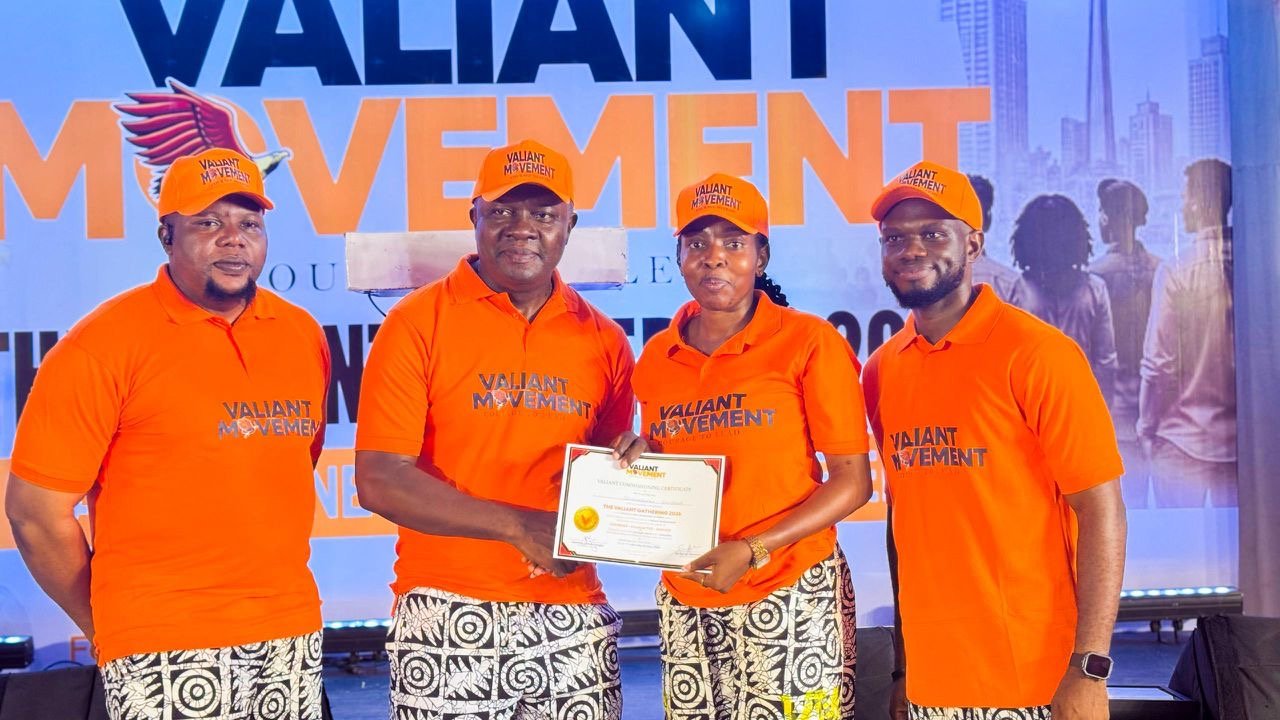
Valentine Ozigbo, business leader and founder of the Valiant Movement, on Saturday, June 13, 2026, convened the organisation’s first National Conference, bringing together coordinators and leaders from all 36 states of the federation and the Federal Capital Territory for a day of orientation, leadership training, and strategic planning.
Held at Hotel De Bently, Abuja, the conference marked a significant milestone for the non-partisan leadership and citizenship development initiative, which is anchored on the principles of courage, character, and capacity.
Activities commenced on Friday, June 12, with a welcome dinner that brought state leaders together for the first time as a national body.
The gathering provided an opportunity for delegates travelling from across the country to build relationships ahead of the conference, reflecting the movement’s belief that enduring national transformation must be rooted in genuine community and shared purpose.
Delegates reconvened on Saturday for the main conference, where they were formally introduced to the movement’s vision, values, structure, and strategic direction before participating in a packed programme featuring presentations by members of the national leadership team.
Delivering the keynote address, Ozigbo, a multiple-award-winning global CEO, described the gathering as fundamentally different from traditional political assemblies.
“This is not merely another conference,” Ozigbo told delegates.
“It’s not another political meeting. It’s not another gathering of people looking for positions or titles or applause. This gathering is different.”
He argued that Nigeria’s most pressing challenge extends beyond politics.
“At its deepest level, Nigeria suffers from a crisis of leadership values, civic consciousness, and moral courage,” he said.
Ozigbo painted a picture of decades of normalised corruption, transactional leadership, and widespread civic disengagement.
“Too many young people have concluded that integrity does not pay,” the acclaimed political leader said.
“Too many leaders now pursue power without purpose.”
While acknowledging leadership failures, he insisted that citizens also bear responsibility for national renewal.
“A nation does not collapse only because leaders fail. A nation also collapses when citizens abandon responsibility,” Ozigbo said.
“A society does not die merely because bad people exist. A society dies when good people surrender responsibility. That is why the Valiant Movement was born.”
Addressing what he described as “the tyranny of blame,” Ozigbo challenged Nigerians to move beyond assigning responsibility for the country’s problems and focus instead on solutions.
“Responsibility is the highest form of power,” he said.
On the question of restructuring, Ozigbo clarified his position.
“When I say restructuring, let me define it. I don’t mean division. I don’t mean hatred. I don’t mean violence. I don’t mean the destruction of Nigeria. I mean the honest redesign of systems and governance structures so that this country can work more fairly, more efficiently, and more sustainably for all its people.”
He argued that political restructuring must be accompanied by a restructuring of values and mindset.
“We must restructure how we think, how we lead, how we speak, how we treat truth, and how we understand citizenship and responsibility, because a corrupt mind will eventually corrupt even the best institutions and constitutions.”
Responding to questions about the movement’s political intentions, Ozigbo emphasised that the nationwide structure was not being built to advance any individual’s political ambitions.
Instead, he described the Valiant Movement as a long-term civic and cultural intervention aimed at transforming leadership culture and citizenship values.
“Even if you produce one president or governor without transforming the culture beneath the system, the nation eventually returns to the same problems,” he said.
“The real battle is deeper than elections. It is a battle for values, civic consciousness, leadership culture, institutional thinking, and responsible citizenship. Our mission is bigger than elections. Our mission is the future of Nigeria itself.”
Prof. Okey Ikechukwu, who gave a keynote address at the conference, examined the habits, values, and disciplines historically associated with successful nation-building, situating the movement’s emergence within a broader philosophical and historical context.
Several members of the national leadership team also addressed delegates on key aspects of the movement’s structure and strategy.
Ms Aziza Uko, the movement’s Director of Strategy, Media and Communications, led the delegates through the movement’s core values and ethical standards, outlining the behavioural expectations and disciplinary boundaries that will govern membership nationwide.
A global communications expert, Ms Uko also addressed the conference on the topic, “Reproducing the Valiant Identity: Training, Communications, and Brand Discipline”.
Director of Membership, Chigozie Alex, presented an overview of the movement’s organisational structure, detailing responsibilities at national, state, local government, and ward levels.
Director of Technology, Emmanuel Samuel, introduced delegates to valiants.me, the movement’s digital platform, which will serve as the central infrastructure for membership management, communications, reporting, and coordination across the country.
National Coordinator Ike Bishop spoke on grassroots mobilisation, community service, voter education, town hall engagement, and digital advocacy.
Director of Finance, Nnamdi Obiechina, outlined the movement’s financial framework, while Director of Legal Services, Barrister Cosmas Anyabolu, provided guidance on legal compliance, disciplinary procedures, and security protocols for coordinators and members.
Director of Projects, Nana Kazaure, unveiled Project 774, an ambitious framework designed to ensure active movement structures across every state, local government area, and ward in Nigeria.
Closing the conference, Ozigbo issued a direct challenge to the assembled leadership.
“History is watching us. Future generations are watching us. Nigeria is watching us,” he said.
“This generation has a decision to make. Will we continue normalising decline, or will we rise to rebuild? Will we continue surrendering responsibility, or will we become builders of a new national culture? If a new Nigeria must emerge, then a new Nigerian must emerge.”
He urged delegates to “rise above fear, rise above selfishness, rise above bitterness, rise above mediocrity, and rise above silence,” and become “voices of truth, examples of integrity, builders of communities, defenders of democracy, and custodians of value.”
Expressing optimism about the movement’s future impact, Ozigbo said he hoped history would one day record that, “when Nigeria stood at a dangerous crossroads, a group of courageous men and women rose with character, conviction, discipline, and purpose, and helped change the direction of our nation.”
“Let us rise with courage. Let us build with character. Let us serve with conviction. And let us become Valiants,” he said.
Several distinguished guests attended the conference, including Most Rev Dr. Martin Uzoukwu, the Bishop of the Roman Catholic Diocese of Minna; Rev Fr John Chinenye Oluoma of the Catholic Archdiocese of Abuja, Dr Tony Offiah, Dr. Ejike Nwene, Mr. Edem Kubbie, Crystal Ikanih-Musa, Sarah Makka, Rev. Juliet Binitie, Mr and Mrs Chris Okafor and Afam Mbanefo.
