





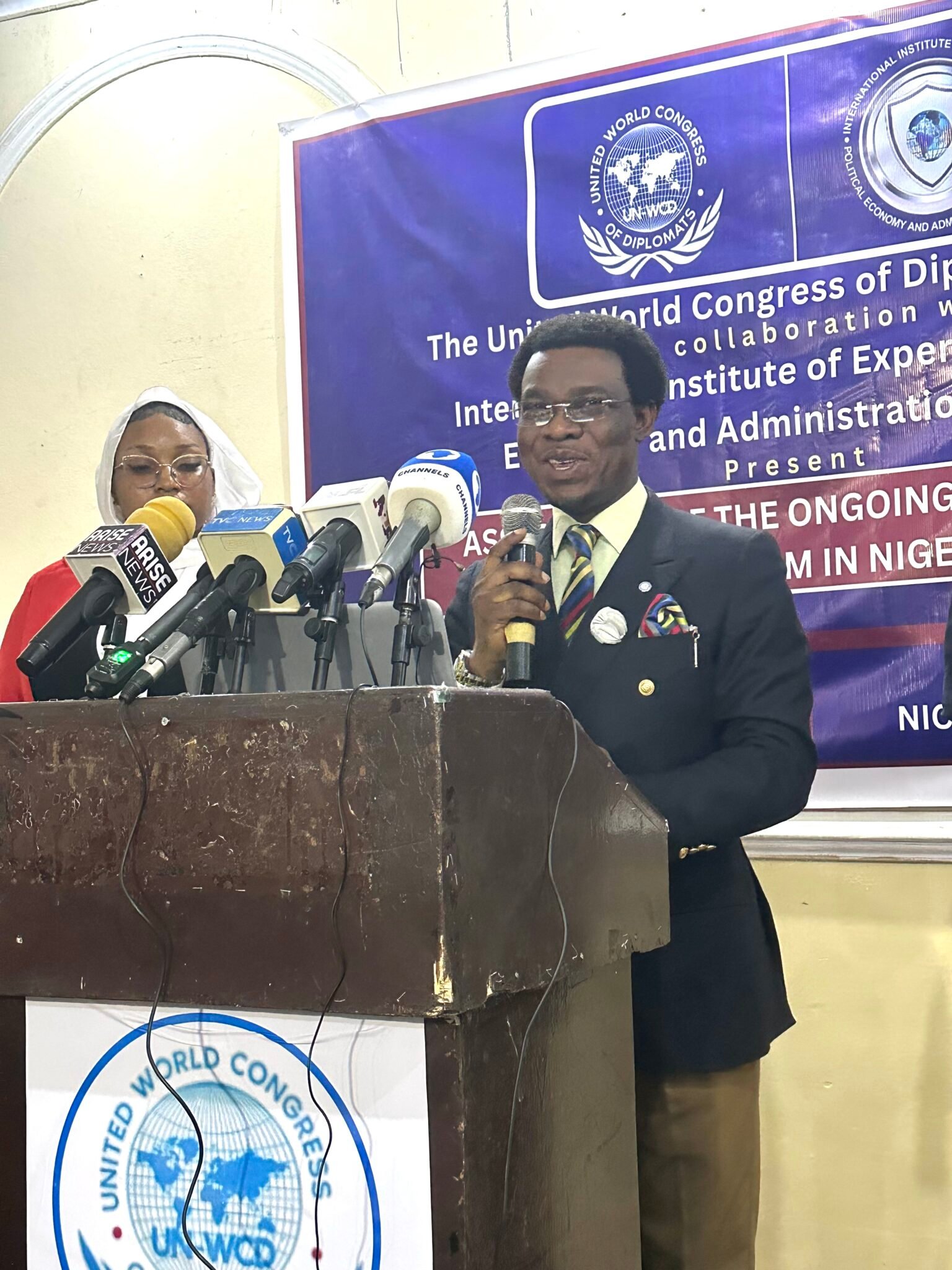
The United World Congress of Diplomats (UN-WCD), in collaboration with the International Institute of Experts on Political Economy and Administration (IIEPEA), on Monday presented an assessment report on Nigeria’s ongoing war against terrorism, highlighting gains recorded through joint military operations with the United States while calling for further institutional reforms to consolidate progress.
The presentation took place at the Nicon Luxury Hotel, Abuja, and was delivered by the Secretary General of UN-WCD, H.E. Amb. Prof. Tunji John Asaolu, before members of the press and other stakeholders.
In his opening remarks, Asaolu described the fight against terrorism as a matter of critical national importance, noting that the collaboration between Nigeria and the United States had yielded significant results. According to the assessment, large-scale joint military operations have been conducted without recorded civilian casualties, a development the organization described as commendable.
He praised the United States military and the Nigerian Ministry of Defence for what he termed “notable victories” against terrorist groups, adding that the cooperation reflects improved operational discipline and adherence to international standards of engagement.
Despite these gains, the UN-WCD expressed concern over continued acts of terror across parts of the country. Asaolu referenced a recent bandit attack at Kasuwan-Daji in Niger State, where over 30 people were reportedly killed, as evidence that remnants of terrorist networks remain active.
The report called for what it described as a “total cleansing” of alleged sponsors of terrorism within critical institutions, warning that unresolved internal sabotage could undermine the successes already recorded in the fight against insurgency and banditry.
Asaolu cautioned against scenarios where external interventions escalate into broader political crises, citing international precedents, and stressed the need for Nigeria to strengthen its internal security architecture through credible and accountable leadership.
While affirming that President Bola Ahmed Tinubu is doing “more than required” to flush out terrorists, the UN-WCD urged Nigerians and institutions to support the President to achieve lasting success in the war against terrorism.
A major highlight of the presentation was a formal call on President Tinubu to consider redeploying the Minister of State for Defence, Bello Matawalle, to another ministry. Asaolu outlined ten key reasons for this recommendation, including allegations of credibility issues linked to Matawalle’s tenure as Governor of Zamfara State, concerns over public trust, and the potential impact on anti-banditry efforts.
Other concerns raised included alleged connections with bandit leaders, accusations of facilitating ransom payments, lack of relevant security experience, and growing public outcry against insecurity. The report also cited calls from respected clerics and commentators for the minister’s removal, warning that his continued stay in the Defence Ministry could undermine both domestic confidence and international perception of Nigeria’s security reforms.
The UN-WCD further argued that redeploying the minister would strengthen ethical governance, protect institutional integrity, and reinforce the administration’s commitment to transparency, accountability, and effective defence sector reforms.
In his closing remarks, Asaolu emphasized that the recommendation was not personal but institutional, stressing that leadership decisions in the security sector must prioritize national interest above all else.
“The redeployment of Bello Matawalle from the Ministry of Defence is not merely a personnel issue; it is a critical step toward reaffirming accountability, integrity, and effective governance essential for Nigeria’s national security,” he said.
He concluded by inviting questions and constructive engagement from stakeholders on the findings and recommendations of the report.
The event underscored renewed calls by diplomatic and policy experts for a holistic, people-centered, and integrity-driven approach to ending terrorism and restoring lasting peace across Nigeria.
